
Why Valgus Knee Collapse Is More Common in Female Ski Racers
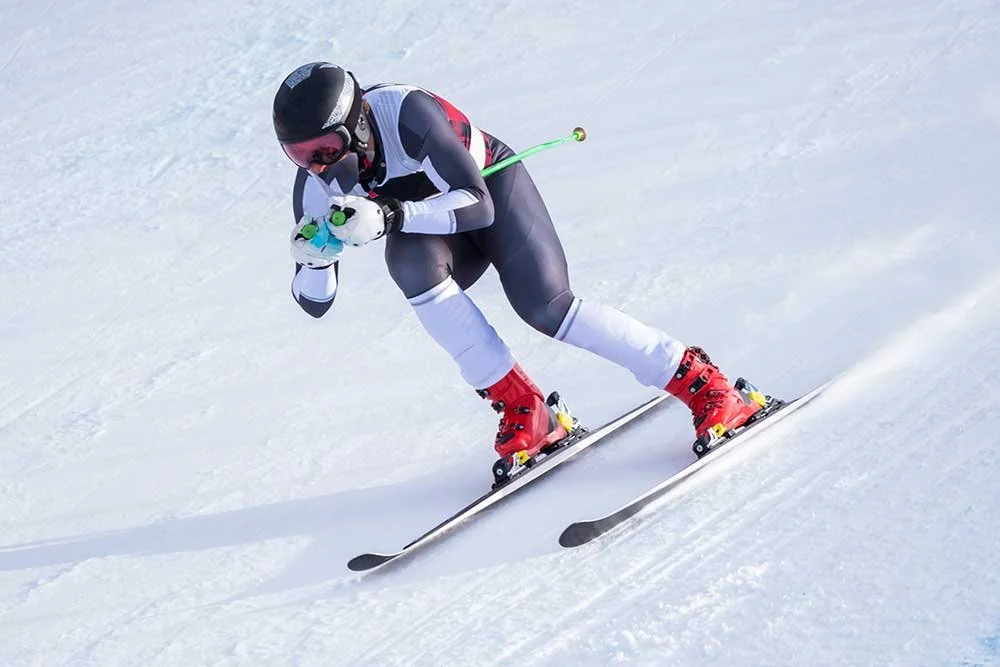
Elite ski racing demands explosive power, edge control, and split second reaction time. Yet one biomechanical pattern continues to show up in injury research and clinical practice: valgus knee collapse occurs more frequently in female athletes, particularly in alpine ski racing.
Below, Dr. William Sterett, former U.S. Ski Team physician and knee specialist at Vail-Summit Orthopaedics & Neurosurgery, explains why this movement pattern is more common in female ski racers and how it connects to ACL injury risk.
Key Takeaways
Valgus knee collapse places rotational stress on the ACL during skiing.
Female ski racers demonstrate higher rates of dynamic knee valgus under load.
Ski racing magnifies biomechanical weaknesses at high speed.
Neuromuscular control plays a larger role than pure strength.
Improving landing mechanics and hip stability reduces ACL injury risk in female athletes.
What Is Valgus Knee Collapse?
Valgus knee collapse, also called dynamic knee valgus, occurs when the knee moves inward relative to the hip and foot during weight bearing activity.
In ski racing, this often happens during edge transitions, landings, or sudden deceleration moments. The inward movement increases strain on the ACL, particularly when combined with rotation.
“Valgus knee collapse is not just the knee drifting inward,” Dr. Sterett explains. “It is a timing and control issue between the hip, knee, and core under load.”
Dynamic knee valgus skiing scenarios are especially risky because the lower leg is fixed inside a rigid ski boot while the upper body rotates independently.
Why Is Valgus Knee Collapse More Common in Female Ski Racers?
The reasons are multifactorial. It is not about toughness or effort. It is about biomechanics.
1. Pelvic Anatomy and Alignment
Female athletes typically have a wider pelvis, creating a greater Q angle between the hip and knee. This alignment can predispose the knee to move inward under load.
In high speed alpine skiing, that small alignment difference can amplify into significant valgus knee collapse when force increases.
2. Neuromuscular Firing Patterns
Research shows female athletes often demonstrate delayed or less coordinated gluteal activation during cutting and landing tasks.
“When the hip muscles do not fire quickly enough, the knee becomes the weak link,” says Dr. Sterett.
This delayed stabilization increases dynamic knee valgus skiing moments, especially during fatigue late in a race run.
3. Strength Is Not the Whole Story
Many elite female ski racers are incredibly strong. However, ACL injury risk in female ski racers is more closely tied to neuromuscular control than absolute strength.
It is not about how much force an athlete can generate. It is about how efficiently that force is controlled in split second transitions.
Why Ski Racing Amplifies the Risk
Ski racing is uniquely demanding on the knee because:
The skis fix the foot and lower leg into a rigid position
The athlete experiences high rotational torque at speed
Edge catch or off balance landings happen instantly
Reaction time is limited
In these moments, even a slight valgus knee collapse can place enormous strain on the ACL.
“Alpine racing does not forgive small errors,” Dr. Sterett explains. “At 50 miles per hour, a few degrees of inward knee motion can translate into major ligament stress.”
This is why ACL injury risk in female ski racers remains elevated compared to males in similar events.
Can Valgus Knee Collapse Be Improved?
Yes. While anatomy cannot be changed, movement patterns can.
Targeted prevention programs focusing on:
Hip abductor strength
Core stability
Single leg balance
Proper landing mechanics
Deceleration control
These have been shown to reduce dynamic knee valgus skiing patterns.
“Training the hips and trunk to stabilize early is critical,” says Dr. Sterett. “It is about teaching the body to react correctly before the knee drifts inward.”
Reducing valgus knee collapse does not eliminate injury risk entirely, but it significantly lowers ACL injury risk in female ski racers.
Final Thoughts from Dr. Sterett
Valgus knee collapse is more common in female ski racers because of alignment, neuromuscular timing, and the extreme demands of alpine racing. It is not a weakness. It is a biomechanical reality that must be addressed through smart training.
“Female athletes are extraordinarily powerful,” Dr. Sterett says. “When we train their mechanics with precision, we can protect the ACL and extend careers.”
Understanding dynamic knee valgus skiing mechanics is the first step toward prevention. With the right training focus, female ski racers can reduce ACL injury risk and compete stronger, longer, and more confidently.