
Why Does My Knee Hurt Going Down Stairs?
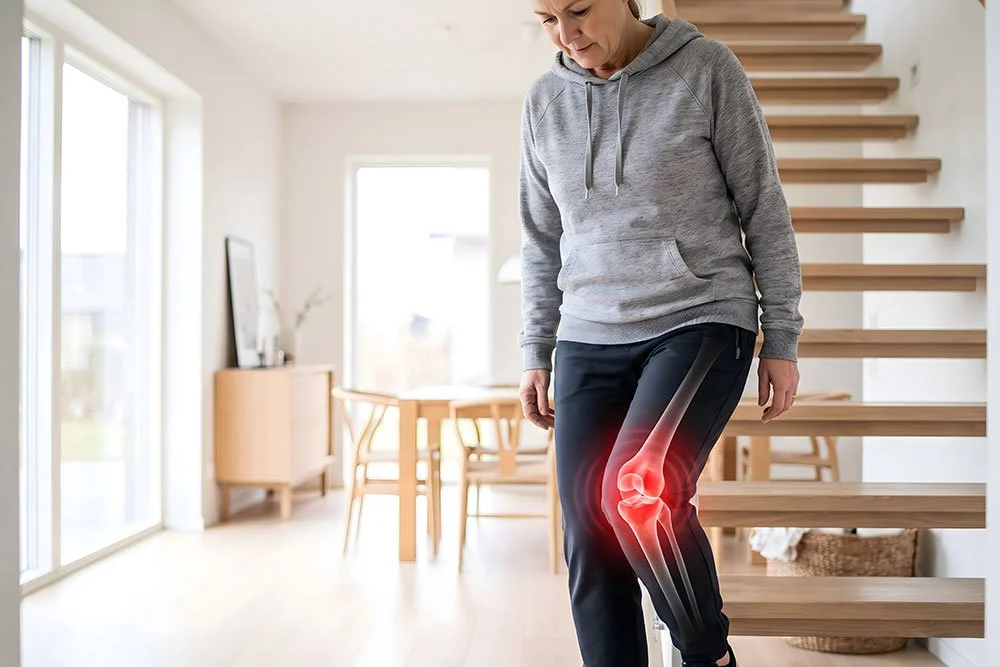
What Your Knee May Be Trying to Tell You
As Dr. William Sterett, a board-certified orthopedic surgeon and sports medicine specialist at Vail-Summit Orthopaedics & Neurosurgery, one of the most common complaints I hear isn't about running, skiing, or hiking.
It's much simpler than that.
Patients tell me, "My knee only really hurts when I go down the stairs."
At first, it doesn't seem like a big deal. Many people continue exercising, walking, or even playing sports without much trouble. But descending stairs places unique forces on the knee, and pain during this everyday activity can provide important clues about what's happening inside the joint.
Going Down Is Harder Than Going Up
Most people assume climbing stairs is tougher on the knees because it requires more effort.
In reality, going down often places greater stress on the knee joint.
As you descend, your quadriceps work to slowly control your body weight while your knee remains bent. This increases pressure between the kneecap and the groove it glides through, while also placing load on the cartilage, meniscus, and surrounding soft tissues.
When one of these structures becomes irritated, stairs are often one of the first activities to become uncomfortable.
Pain Behind the Kneecap Often Points to Patellofemoral Pain
One of the most common causes of pain going downstairs is patellofemoral pain syndrome.
Patients typically describe a dull ache behind or around the kneecap. It may develop after increasing activity, beginning a new workout routine, or spending long periods sitting before standing up.
Interestingly, the knee often doesn't feel unstable or swollen. It simply hurts during activities that load the front of the joint, such as stairs, squatting, lunging, or getting up from a chair.
The good news is that patellofemoral pain frequently responds well to improving hip and leg strength, correcting movement mechanics, and gradually returning to activity.
Sometimes the Cartilage Is Wearing Down
Pain on stairs can also be an early sign of cartilage wear, particularly in adults over 40.
Healthy cartilage allows the bones of the knee to glide smoothly against one another. As cartilage begins to thin, the joint becomes less efficient at absorbing force.
Patients often notice stiffness after sitting, discomfort when descending hills or stairs, and occasional grinding or crunching sensations within the knee.
Not every patient with cartilage wear has severe arthritis. In many cases, identifying the problem early allows us to manage symptoms and keep patients active for years.
A Meniscus Injury Can Feel Different
When patients describe sharp pain along one side of the knee, I also consider the meniscus.
The meniscus acts as a shock absorber inside the knee. It helps distribute force and stabilize the joint during movement.
A torn meniscus may cause pain while twisting, squatting, or going downstairs. Some patients also notice catching, locking, or the feeling that something is interfering with the knee's motion.
Unlike simple soreness, these mechanical symptoms often suggest that the meniscus deserves a closer look.
Not Every Painful Knee Needs an MRI
Many patients assume imaging is the first step.
In reality, the physical examination often tells us far more than people expect.
The location of the pain, how symptoms began, whether swelling is present, and which movements reproduce discomfort all help narrow the diagnosis before imaging is considered.
If symptoms persist despite conservative treatment, the knee locks, significant swelling develops, or surgery becomes a possibility, advanced imaging may then be appropriate to better understand the underlying problem.
The goal isn't simply to find something abnormal on an MRI. It's to determine which finding is actually responsible for your symptoms.
When Should You Have Your Knee Evaluated?
Occasional soreness after an unusually active weekend isn't uncommon.
However, if your knee consistently hurts every time you go downstairs, the pain is worsening, or you're beginning to avoid everyday activities because of it, it's worth having the knee evaluated.
Many of the conditions that cause stair pain respond very well to early treatment. Whether it's patellofemoral pain, cartilage wear, a meniscus injury, or another source of knee pain, identifying the cause early often leads to more treatment options and a faster return to the activities you enjoy.
Pain going downstairs may seem like a small problem—but it's often your knee's way of telling you that something deserves attention. An accurate diagnosis is the first step toward keeping you moving comfortably and confidently.